

Swelling after wisdom teeth removal is common and, in most cases, part of normal healing. The gum and jaw tissues have been stretched or disturbed, and the body sends fluid and repair cells to the area. Swelling alone does not always mean infection.
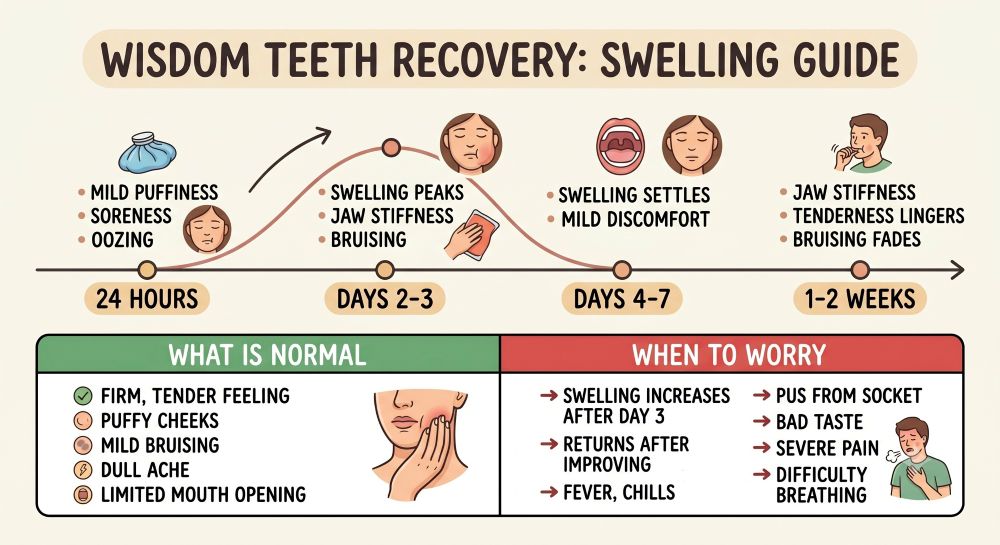
Most swelling appears within the first day or two. It may feel worst around days two and three, then slowly ease. Swelling and discomfort are often worse for the first three days and can last up to two weeks.
Why swelling happens
Wisdom tooth extraction can be more involved than removing another tooth. Some wisdom teeth are impacted, partly covered by gum, angled into the next tooth, or need to be removed in sections.
Swelling may be more obvious when:
- More than one wisdom tooth was removed
- The tooth was impacted
- Bone had to be removed
- The procedure took longer than expected
- You did too much too soon after going home
One cheek may swell more than the other if one side needed more work. That can still be normal if the swelling starts to settle.
Wisdom teeth swelling timeline
| Time after surgery | What may be normal |
| First 24 hours | Mild puffiness, oozing, soreness and a heavy feeling |
| Days 2 to 3 | Swelling may peak. Jaw stiffness and bruising can increase |
| Days 4 to 7 | Swelling should begin to settle |
| 1 to 2 weeks | Mild tenderness, bruising or stiffness may linger |
If you are preparing for wisdom teeth removal, ask whether your teeth are simple or complex to remove. Complexity often affects swelling, time off work and aftercare.
What normal swelling feels like
Normal swelling usually feels firm, tender and tight rather than hot or sharply painful. You may find it harder to open your mouth wide, chew normally or sleep on that side. Puffy cheeks, mild bruising, jaw stiffness, soreness when chewing and a dull ache near the socket can fit within early recovery. These symptoms should become easier after the early peak.
When swelling is not normal
The pattern matters. Swelling that keeps increasing after day three, returns after improving, or comes with other symptoms needs professional advice.
Call your dentist or oral surgeon if you notice:
- Swelling that gets worse after day three
- Swelling that improves, then returns
- Fever, chills or feeling unwell
- Pus or fluid from the socket
- A salty, sour or persistent bad taste
- Redness, heat or spreading tenderness
- Severe or increasing pain
- Difficulty swallowing or breathing
Breathing difficulty, rapidly spreading facial swelling or swelling under the jaw should be treated as urgent.
Swelling, infection and dry socket
Swelling, infection and dry socket are often confused. Infection may cause swelling with fever, redness, pus, worsening pain and a bad taste. The American Association of Oral and Maxillofacial Surgeons lists fever, increased pain, swelling, redness, prolonged bad taste and pus as possible infection signs.
Dry socket is usually more about pain than puffiness. Mayo Clinic describes dry socket pain as severe and sometimes spreading to the ear, eye, temple or neck on the same side. Here’s a simple guide: swelling that peaks and then settles is usually reassuring. Pain or swelling that suddenly worsens deserves a check.
Swelling is only one part of healing, and our broader wisdom teeth removal recovery guide explains what to expect day by day, from early soreness and diet changes through to the later stages of recovery.
How to reduce swelling safely
Always follow the instructions given by your clinician. General aftercare often includes:
- Rest with your head slightly raised
- Use cold packs early if advised
- Eat soft, cool or lukewarm foods
- Drink water, but avoid straws early on
- Avoid smoking and vaping
- Do not spit forcefully or rinse vigorously at first
Do not poke the socket to check healing. This can disturb the clot.
Wisdom teeth removal cost can vary depending on tooth position, sedation and how many teeth need removal. This guide to explains common fee factors.
If you are unsure, do not guess. Contact a wisdom teeth dentist promptly if swelling is worsening, spreading, painful, or paired with fever, pus or breathing concerns.
Frequently Asked Questions
How long does swelling last after wisdom teeth removal?
Swelling often appears in the first 48 hours and may peak around days two to three. For many people, it improves over the next several days. Mild puffiness, bruising or jaw stiffness can last longer after complex or impacted wisdom tooth removal.
Is swelling worse on day three normal?
Yes, it can be normal. Day three is often when swelling looks or feels most noticeable. The concern is swelling that keeps growing after that point, especially with fever, pus, spreading redness or worsening pain.
Why is one cheek more swollen than the other?
One side may have needed more surgical work. Uneven swelling can be normal, but a hot, increasingly painful or rapidly enlarging cheek should be checked.
Can swelling mean infection after wisdom tooth extraction?
Sometimes. Infection is more likely when swelling comes with fever, pus, a bad taste, spreading redness or pain that is getting worse instead of better.
Should I use ice or heat for wisdom teeth swelling? Follow your clinician’s advice. Ice is often used early for swelling. Heat may be suggested later for jaw stiffness, depending on your recovery.