


Recovering from wisdom teeth removal is usually much easier when you know what is normal, what needs a bit more care, and when to get in touch. The first few days can feel uncertain because swelling, soreness, and changes to eating are expected, but they can still catch people off guard. A clear recovery plan makes the whole process feel more manageable.
At Dr Paulo Pinho, we guide patients through wisdom teeth removal with practical aftercare, clear follow-up advice, and support during healing. Most patients go home the same day, many return to normal activities within about a week, and the extraction site itself usually continues healing over the following two weeks and beyond.
This guide explains what recovery looks like in 2026, from the first few hours after treatment through to the later stages of healing. It also covers what to eat, what to avoid, how to reduce swelling, when to rest, and which warning signs should not be ignored.
What recovery really means after wisdom teeth removal
When people ask how long recovery takes, they are often asking two different questions at once. The first is how long it takes to feel more comfortable. The second is how long it takes for the extraction site to heal properly.
Those two timelines are not exactly the same. Comfort usually improves much sooner than full healing. Many patients find the first two or three days the hardest, then notice things settling as the week goes on. The gum socket generally needs around two weeks to heal, while deeper healing under the surface continues after that. That is why you may feel much better before the area is fully healed.
The recovery experience also depends on the number of teeth removed, how impacted they were, your general health, and how closely you follow aftercare instructions. A simple extraction and a more involved removal can feel quite different afterwards. That is one reason it helps to focus on your own progress rather than comparing yourself too closely with someone else’s story.
If you are having all four wisdom teeth removed in one appointment, read our recovery tips for having all four wisdom teeth removed to learn how to manage swelling, protect the extraction sites and plan your first few days of healing.
The first few hours after treatment
The first stage of recovery begins before the numbness has even worn off. Your mouth may feel heavy, puffy, or strange to move, and you may notice a slight metallic taste from a small amount of blood. This is usually expected straight after the procedure.
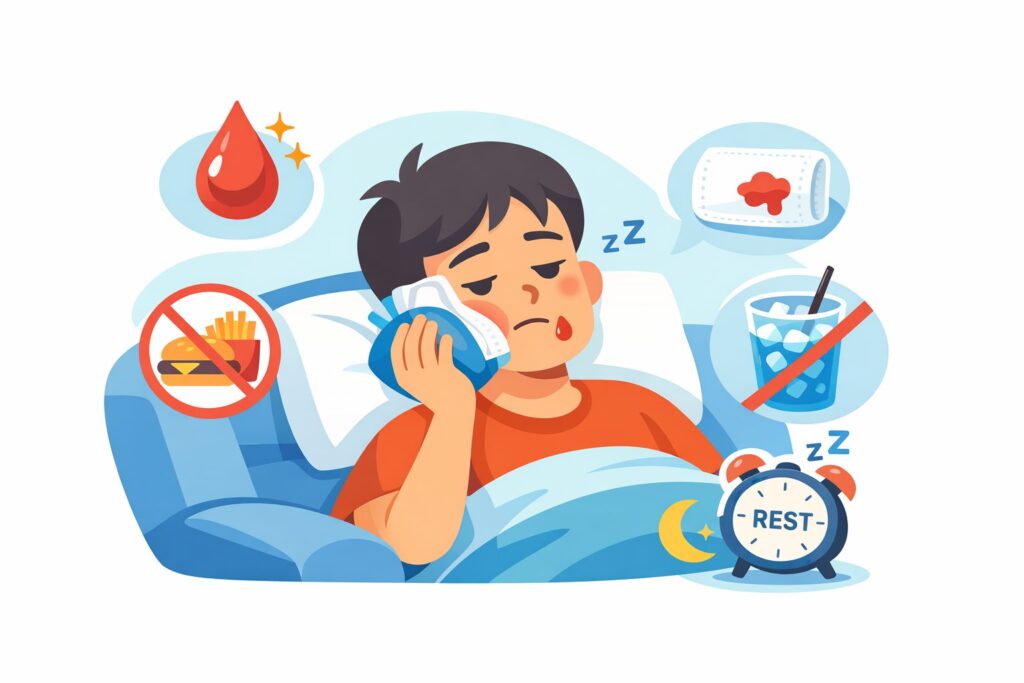
During these first hours, the main priorities are protecting the blood clot, controlling bleeding, and avoiding accidental injury while the mouth is still numb. You should avoid eating while the numbness is still present, avoid biting your lips, cheeks, or tongue, and stick to cold drinks at first if needed. If gauze has been placed, bite down on it as instructed to help the area settle. NSW oral health guidance also advises against swishing, spitting, using a straw, or exercising in the first 24 hours, because these actions can disturb the clot and interfere with healing.
This early stage is also when rest matters most. Keep the day light, stay home, and let the anaesthetic wear off fully before trying to do too much. If you have had sedation or general anaesthesia, follow the instructions given to you about transport, supervision, and returning to normal activities.
Day 0 to Day 1: settling the area
The first day is about protecting the area and keeping inflammation down. Some oozing is normal. A little swelling is normal too. Pain often begins once the anaesthetic fades, so this is the point where prescribed or recommended pain relief becomes important.
Cold packs on the cheek can help during the first day. They do not remove swelling entirely, but they can make the early stage more comfortable. Resting with your head elevated can also help. We usually recommend taking it easy, staying well hydrated, and keeping food choices soft, cool, and easy to manage. Soft foods and cold or lukewarm options are generally easier than anything hot, crunchy, or difficult to chew.
This is also the stage where people are tempted to “check” the socket too often. It is better not to poke the area with your tongue or fingers. The blood clot is there for a reason. Protecting it gives you the best chance of smoother healing over the next few days.

Days 1 to 2: swelling and soreness usually build
Many patients expect the worst part to happen immediately after surgery, but the second day can actually feel more uncomfortable than the first. Swelling often becomes more noticeable at this stage, jaw stiffness can increase, and eating may still feel awkward.
This does not necessarily mean anything is wrong. It is a common part of the normal inflammatory response. The mouth has gone through treatment, and the tissues need time to settle. You may feel like the face looks puffier, the jaw feels tighter, and opening wide is harder than usual. That can be especially noticeable when more than one tooth has been removed.
The best approach here is usually steady rather than dramatic. Keep up with the aftercare instructions you were given, continue with appropriate pain relief, stay hydrated, and keep meals soft. Many people do better with small, easy meals rather than trying to force a normal plate of food too soon. Yoghurt, mashed vegetables, soft eggs, smoothies eaten without a straw, soups that are not hot, pasta, and similar foods are often easier during this stage.
Days 3 to 4: the turning point for many patients
For a lot of people, this is the stage where recovery starts to feel less uncertain. Swelling may still be present, but it often stops getting worse. Pain often becomes easier to manage. Mouth opening may still feel tight, yet the overall trend begins to move in the right direction.
That said, not everyone feels dramatically better by Day 3. Recovery is not identical from person to person. The more involved the removal, the more gradual the improvement may be. What matters most is the direction of travel. If the soreness is steady or slowly easing, that is very different from pain that suddenly becomes much worse.
This distinction matters because worsening pain after the first few days can be a warning sign. Ongoing severe pain, increasing swelling, heavy bleeding, fever, or a bad taste that does not settle should not be ignored. Healthdirect advises speaking to your dentist if you have very bad ongoing pain, a lot of bleeding, a temperature over 38°C, or swelling that does not go down or gets worse.
Days 5 to 7: getting back to normal routine
By the end of the first week, many patients feel much closer to themselves again. Work, study, and ordinary daily activities often become more manageable, even if the mouth still feels a little tender. Healthdirect notes that many people return to normal activities within about a week after wisdom teeth removal.
This does not mean everything is back to baseline. The socket is still healing, food can still collect around the area, and the gum may remain sensitive. But in practical terms, this is the point where many people stop feeling like recovery is taking over the whole week.
It is still wise to be sensible. Hard exercise, rough chewing near the sockets, smoking, alcohol, and neglecting mouth care can all make recovery harder than it needs to be. Even once you feel more normal, the tissues are still recovering. A good week-one mindset is “better, but not careless.”
Week 2: healing becomes less obvious but still matters
By week two, the dramatic part of recovery is usually over. Swelling has usually eased a lot. Eating becomes easier. The mouth starts to feel more usable again. But this is also the stage where people can forget that healing is still going on.
The wound itself often needs about two weeks to heal, which is why week two still matters. The socket may look different from one day to the next, and that can worry some patients, but appearance alone is not always a sign of trouble. What matters more is whether pain is settling, swelling is improving, and there are no signs of infection or significant bleeding.
We commonly recommend a review around 7 to 14 days after surgery so healing can be checked properly. Dissolving stitches usually do not need removal, and we provide a post-operative follow-up appointment free of charge so patients can feel confident that recovery is progressing as expected.
Weeks 3 to 4: feeling normal again
By weeks three and four, most people feel close to normal in everyday life. Chewing is easier, tenderness is much lower, and the recovery period no longer feels front of mind. This stage is often less about pain and more about patience. The mouth feels better well before all deeper healing has finished.
This is why it helps to think of recovery in layers. The first layer is the early discomfort and swelling. The second is gum healing. The third is deeper healing beneath the surface. You do not need to feel every stage for it to be happening.
Patients are often reassured by knowing that it is normal to feel mostly fine while the body is still completing its work underneath. If the overall trend is better week by week, that is usually what we want to see.
What is normal during recovery and what is not
A lot of recovery anxiety comes from not knowing what is expected. Some symptoms are common and usually not a cause for alarm. Others deserve attention sooner.
These are often normal during the first stage of healing:
- Mild bleeding or oozing early on
- Swelling, especially in the first two to three days
- Jaw stiffness
- Soreness when chewing
- Tiredness after treatment
- Mild bruising in some cases
These symptoms deserve a call:
- Bleeding that does not settle with pressure
- Pain that becomes worse rather than better after the first few days
- Fever
- Swelling that keeps increasing
- Difficulty swallowing or breathing
- A persistent bad taste with worsening symptoms
Heavy bleeding, severe pain, and swelling that fails to settle are not things to “just wait out” without advice. NSW oral health guidance also states that if the socket starts to bleed, you should bite on gauze for 30 minutes and repeat as needed, and seek urgent help for uncontrolled bleeding.
What to eat after wisdom teeth removal
Food makes a big difference to comfort in the first week. Right after treatment, stick with cool or lukewarm options that do not need much chewing. As the days go on, move into more substantial soft foods, then gradually build back towards normal eating as comfort allows.
Good early choices often include yoghurt, smoothies without a straw, mashed potato, scrambled eggs, soft pasta, pudding, cooled soup, applesauce, porridge, and soft fish. The aim is not to live on sugar or ice cream alone. Recovery tends to feel better when you are hydrated and getting enough protein and energy, even if meals are simple. NSW oral health guidance recommends soft and cool foods in the first 24 hours, and our own recovery advice also centres on soft foods while the area settles.
What should be avoided at first? Anything crunchy, sharp, spicy, very hot, sticky, or difficult to chew. These foods can irritate the area, become trapped in the socket, or make the mouth work harder than it should while healing is still early.
Rest, sleep, exercise, and daily routine
Recovery is not only about what goes on in the mouth. The way you handle the first few days matters too.
Rest helps. Sleeping with your head slightly elevated can reduce that heavy, throbbing feeling some people notice when lying flat. Intense exercise should be avoided early on because it can increase bleeding and worsen swelling. Healthdirect and NSW oral health guidance both recommend resting and avoiding physical activity in the first 24 hours after extraction.
Hydration matters as well, but skip the straw. Suction can disturb the clot during early healing. Smoking is another habit worth avoiding, especially in the first 24 hours and ideally for longer, because it can interfere with recovery and raise the risk of complications.
Oral hygiene during recovery
Keeping the mouth clean matters, but the timing and technique matter too. The first day is not the time for vigorous rinsing or aggressive brushing near the extraction site. After the first 24 hours, gentle cleaning becomes important because plaque and food build-up do not help healing.
That balance is important. You do not want to disturb the socket, but you also do not want the rest of the mouth to become neglected. NSW oral health guidance specifically notes that after 24 hours, gentle brushing is important because clean teeth support healing.
If you have been given specific instructions for saltwater rinsing or other aftercare, follow those directions rather than improvising. Recovery usually goes more smoothly when the plan is simple and consistent.
A recovery guide is helpful, but follow your own instructions first
General guidance is helpful because it tells you what most patients experience. Your own instructions still come first. They are based on your teeth, your treatment, your medical history, and how many teeth were removed.
That is why we make aftercare a clear part of the process rather than leaving patients to figure it out alone afterwards. We also offer free post-operative follow-up so your healing can be checked properly and questions can be answered as recovery progresses.
Start with the right support
Wisdom teeth removal recovery is usually very manageable when patients know what to expect and when to take things seriously. The first few days are often the most uncomfortable. By the end of the first week, many people are back to normal routine, and by week two the area is usually healing well. The key is protecting the clot early, resting when needed, keeping food soft, avoiding the habits that disrupt healing, and getting advice promptly if something feels off.
If you need wisdom teeth removal in Sydney and want clear aftercare, practical guidance, and follow-up support during healing, book a consultation with Dr Paulo Pinho. We will explain your options, talk you through recovery, and help you feel more prepared from the start.